 By astroguria6@gmail.com
Navratri is one of the most spiritually significant Hindu festivals, dedicated to the worship of Goddess Durga and her nine divine forms, collectively known as Navdurga. Celebrated during the Hindu month of Ashwin, this nine-night festival is a time for devotion, fasting, prayer, meditation and spiritual renewal.
In 2026, Sharadiya Navratri begins on Sunday, 11 October 2026, with Ghatasthapana or Kalash Sthapana. The nine days of Navratri worship continue through 19 October 2026, while Vijayadashami (Dussehra) will be observed on Tuesday, 20 October 2026.
For devotees, Navratri is not only a festival but also an opportunity to seek the blessings of Maa Durga, remove negativity, strengthen inner confidence and begin a new spiritual cycle.
Let us understand the Sharadiya Navratri 2026 dates, Ghatasthapana Muhurat, Navdurga forms, puja samagri, puja vidhi, fasting guidelines and spiritual significance in detail.
When Is Sharadiya Navratri 2026?
Sharadiya Navratri 2026 will begin on:
Sunday, 11 October 2026
The Navratri celebrations will continue for nine days, with devotees worshipping a different form of Goddess Durga each day.
The festival will culminate with Vijayadashami on Tuesday, 20 October 2026, which marks the victory of good over evil in the traditional Ramayana narrative and is also associated with the victory of Goddess Durga over Mahishasura.
Sharadiya Navratri 2026 Dates at a Glance
| Date | Day | Navratri Worship |
|---|---|---|
| 11 October 2026 | Sunday | Ghatasthapana – Maa Shailputri |
| 12 October 2026 | Monday | Maa Brahmacharini |
| 13 October 2026 | Tuesday | Maa Chandraghanta |
| 14 October 2026 | Wednesday | Maa Kushmanda |
| 15 October 2026 | Thursday | Maa Skandamata |
| 16 October 2026 | Friday | Maa Katyayani |
| 17 October 2026 | Saturday | Maa Kaalratri |
| 18 October 2026 | Sunday | Maa Mahagauri |
| 19 October 2026 | Monday | Maa Siddhidatri – Maha Navami |
| 20 October 2026 | Tuesday | Vijayadashami / Dussehra |
According to the available 2026 festival calendar, Maha Ashtami and Maha Navami fall together on 19 October, because of the tithi sequence that year.
Ghatasthapana 2026: Date and Muhurat
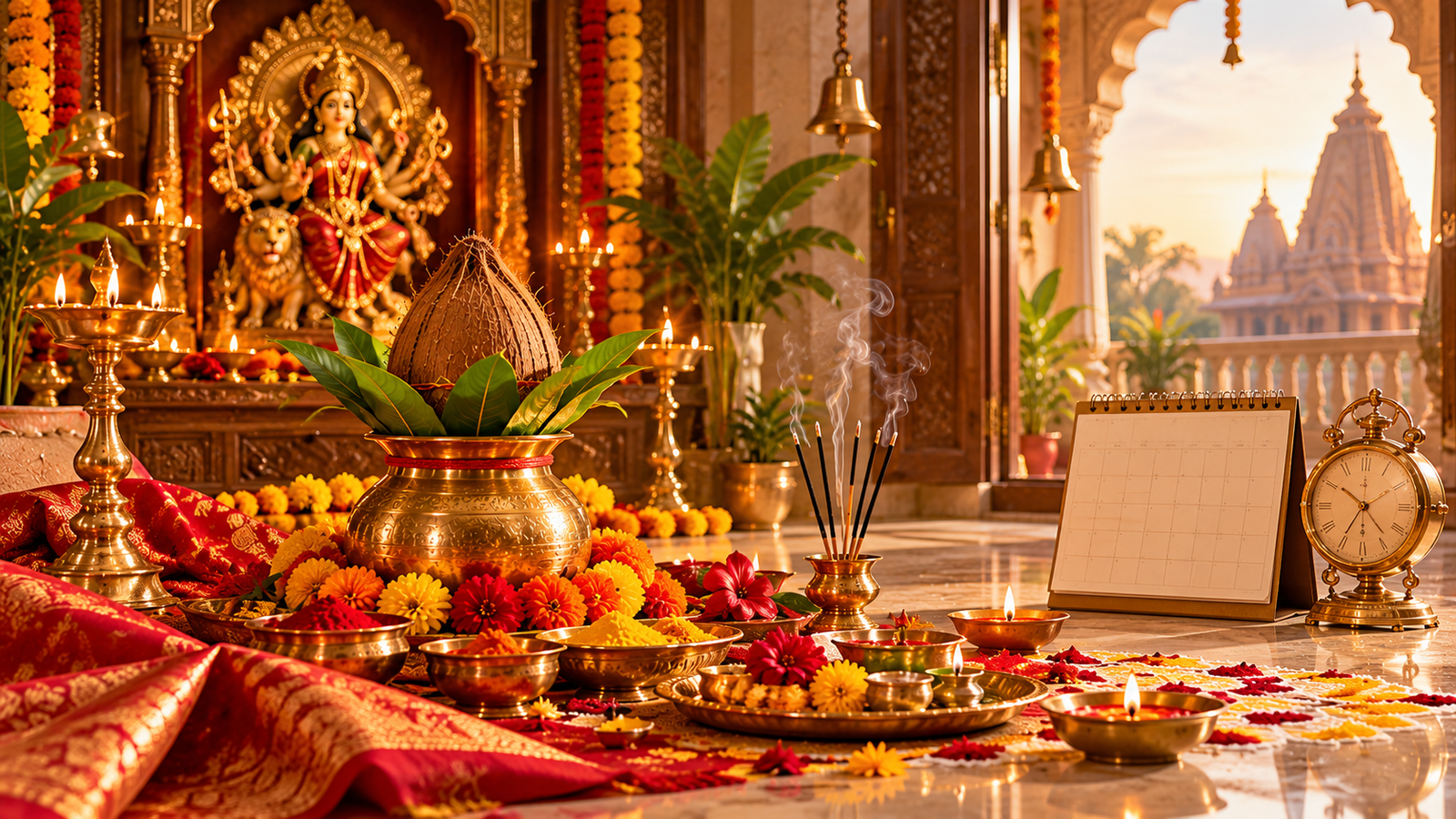
Ghatasthapana, also known as Kalash Sthapana, marks the beginning of Sharadiya Navratri worship.
On this day, devotees establish a sacred Kalash and invoke Goddess Shakti. It is considered one of the most important rituals of Navratri.
For Delhi, Drik Panchang lists the following 2026 Ghatasthapana timings:
Date: Sunday, 11 October 2026 Ghatasthapana Muhurat: 6:19 AM to 10:12 AM Abhijit Muhurat: 11:44 AM to 12:31 PM
The exact Muhurat can vary according to location because sunrise, sunset and other Panchang calculations differ from one city to another. Therefore, devotees should check the local Panchang for their city before performing the ritual.
The Pratipada Tithi begins on 11 October at 9:30 PM according to the Delhi calculation.
Why Is Ghatasthapana Important?
Ghatasthapana symbolically represents the invocation of divine Shakti into the home.
The Kalash represents abundance, purity and divine consciousness. Establishing it at the beginning of Navratri creates a sacred focal point for the nine days of worship.
Traditional Panchang guidance recommends performing Ghatasthapana during the appropriate daytime period while Pratipada Tithi is prevailing and avoiding unsuitable periods such as nighttime.
Navdurga: The Nine Forms of Maa Durga
During the nine days of Sharadiya Navratri, devotees worship nine forms of Goddess Durga.
Day 1 – Maa Shailputri
Maa Shailputri is worshipped on the first day of Navratri.
She represents strength, stability and purity. Devotees pray to her for a strong foundation and inner determination.
This day also marks the beginning of the Navratri spiritual journey.
Day 2 – Maa Brahmacharini
Maa Brahmacharini represents devotion, discipline, patience and spiritual strength.
Devotees worship her for the ability to remain focused and patient while facing challenges in life.
Day 3 – Maa Chandraghanta
Maa Chandraghanta is associated with courage, peace and protection.
Her worship is traditionally connected with overcoming fear and developing inner confidence.
Day 4 – Maa Kushmanda
Maa Kushmanda is associated with creative energy and cosmic power.
Devotees seek her blessings for vitality, positivity, abundance and the strength to move forward.
Day 5 – Maa Skandamata
Maa Skandamata is worshipped as the mother of Lord Kartikeya.
She represents maternal love, compassion and protection.
Devotees pray to her for family happiness, emotional strength and divine protection.
Day 6 – Maa Katyayani
Maa Katyayani is associated with courage and divine power.
Many devotees worship her while praying for the removal of obstacles and for strength in personal and family matters.
Day 7 – Maa Kaalratri
Maa Kaalratri represents the powerful aspect of Goddess Durga.
Her worship is traditionally associated with protection from fear, negativity and darkness.
The seventh day is considered particularly significant for devotees who wish to strengthen their spiritual discipline.
Day 8 – Maa Mahagauri
Maa Mahagauri represents purity, peace and spiritual cleansing.
Devotees seek her blessings for peace of mind, harmony and purification of thoughts and intentions.
Day 9 – Maa Siddhidatri
Maa Siddhidatri is worshipped on the ninth day.
She is associated with spiritual wisdom, divine blessings and the fulfilment of sincere spiritual aspirations.
The ninth day marks the completion of the primary nine-day Navratri worship cycle.
Sharadiya Navratri Puja Samagri
If you are planning to perform Navratri Puja at home, you can keep the following items ready:
- Maa Durga idol or picture
- Kalash
- Clean water
- Mango leaves
- Coconut
- Red cloth
- Roli or Kumkum
- Turmeric
- Akshat (rice)
- Red flowers
- Durva grass, where traditionally used
- Incense sticks
- Dhoop
- Camphor
- Diya and ghee/oil
- Cotton wicks
- Fruits
- Sweets or traditional Bhog
- Panchamrit ingredients
- Mauli/Kalava
- Betel leaves and betel nuts, according to family tradition
- Mata Rani's Chunri
- Seasonal or traditional offerings
The exact list may vary according to regional customs and family traditions.
How to Perform Ghatasthapana at Home
Here is a simple traditional procedure for devotees who wish to perform Kalash Sthapana at home.
Step 1: Clean the Puja Area
Clean the room and especially the area where the Kalash and Maa Durga's idol will be placed.
Take a bath and wear clean clothes before beginning the Puja.
Step 2: Prepare the Puja Chowki
Place a clean red or yellow cloth on the Puja Chowki and place the image or idol of Maa Durga.
Step 3: Prepare the Kalash
Fill a clean Kalash with water and add traditionally used auspicious items according to your family tradition.
Place mango leaves around the mouth of the Kalash and place a coconut on top.
Step 4: Establish the Sacred Kalash
Place the Kalash in the designated Puja area and perform the Sankalp for the nine days of Navratri.
Step 5: Invoke Maa Durga
Light the diya and incense and offer flowers, Kumkum, Akshat and other Puja items to Maa Durga.
Chant Durga Mantras according to your tradition.
Step 6: Perform Aarti
Complete the Puja with Maa Durga Aarti and pray for peace, protection, prosperity and spiritual strength.
The most important aspect of Navratri Puja is devotion and sincerity.
Why Is Sharadiya Navratri Spiritually Important?
Navratri is traditionally viewed as a period of devotion, purification and renewal.
The nine forms of Maa Durga can also be understood symbolically as different expressions of Shakti—strength, discipline, courage, creativity, compassion, protection, purity and spiritual wisdom.
For many devotees, these nine days provide an opportunity to:
- Spend more time in prayer
- Reduce negativity
- Practice meditation
- Develop discipline
- Reflect on personal goals
- Express gratitude
- Strengthen spiritual practices
- Seek divine guidance
- Begin new intentions with faith
Navratri is therefore not only about external rituals. It can also become a period of inner reflection and conscious transformation.
Maha Ashtami and Maha Navami 2026
Maha Ashtami is traditionally considered one of the most important days of Navratri.
In 2026, the tithi arrangement means Maha Ashtami and Maha Navami are observed on 19 October in the referenced calendar calculations.
Many families perform Kanya Puja/Kumari Puja on Ashtami or Navami according to their family tradition.
Young girls are traditionally worshipped as manifestations of the Divine Feminine, and devotees offer them food, gifts and blessings.
Because traditions differ, families should follow the custom they have traditionally observed.
Vijayadashami 2026: When Is Dussehra?
After the nine-day Navratri worship, Vijayadashami or Dussehra will be observed on Tuesday, 20 October 2026.
Vijayadashami represents victory over evil and is associated with the conclusion of the Navratri period.
In different parts of India, the day is celebrated through different traditions, including:
- Ravan Dahan
- Durga Visarjan
- Shastra Puja
- Religious processions
- Cultural celebrations
- Family gatherings
The way Vijayadashami is celebrated varies significantly across regions.
Simple Navratri Mantra
Devotees can chant simple Durga mantras during Navratri according to their spiritual tradition.
One commonly recited mantra is:
“Om Dum Durgayai Namah.”
You can chant it with a calm mind and sincere devotion.
You may also recite Durga Chalisa, Durga Saptashati or other traditional prayers if they are part of your regular spiritual practice.
What Should You Do During Navratri?
Navratri can be used as a period of spiritual discipline and positive reflection.
You can:
1. Keep Your Thoughts Positive
Try to reduce unnecessary negativity, arguments and stressful interactions.
2. Spend Time in Prayer
Even a few minutes of sincere prayer every day can become a meaningful spiritual practice.
3. Practice Meditation
Meditation can help create a peaceful environment for self-reflection.
4. Keep Your Home Clean
Many devotees clean and decorate their homes before Navratri as part of their festival preparations.
5. Help Others
Charity, food donation and helping those in need are traditionally considered meaningful acts during spiritual festivals.
6. Set Positive Intentions
Navratri can be a good time to reflect on what you want to improve in your personal, professional and spiritual life.
Navratri and Spiritual Energy
From a spiritual perspective, Navratri is often seen as a period when devotees turn their attention inward.
The nine forms of Goddess Durga can be viewed as a journey through different aspects of Shakti—from stability and discipline to courage, purification and spiritual wisdom.
Rather than focusing only on external rituals, you can use these nine days to ask yourself:
What do I need to release? What do I want to strengthen? Where do I need greater clarity? What kind of energy do I want to bring into the next phase of my life?
These reflections can make Navratri a deeply personal and meaningful experience.
Frequently Asked Questions About Sharadiya Navratri 2026
When does Sharadiya Navratri 2026 begin?
Sharadiya Navratri 2026 begins on Sunday, 11 October 2026.
When is Ghatasthapana in 2026?
Ghatasthapana will be performed on 11 October 2026. The exact Muhurat depends on the location. For Delhi, the listed Ghatasthapana Muhurat is 6:19 AM to 10:12 AM, with an Abhijit Muhurat from 11:44 AM to 12:31 PM.
When is Maha Ashtami in 2026?
Due to the tithi arrangement, Maha Ashtami and Maha Navami are observed on 19 October 2026 in the referenced calendar.
When is Navami in 2026?
Maha Navami is observed on 19 October 2026 in the referenced 2026 calendar.
When is Dussehra in 2026?
Vijayadashami/Dussehra will be observed on Tuesday, 20 October 2026.
Can Navratri Puja be performed at home?
Yes. Devotees can perform simple Navratri Puja at home by following their family tradition, establishing the Kalash, worshipping Maa Durga, offering Bhog and performing Aarti.
Is fasting compulsory during Navratri?
No single fasting practice applies to everyone. Many devotees fast, while others simply follow a devotional routine and worship Maa Durga. Practices vary according to family and regional traditions.
Sharadiya Navratri 2026 is a beautiful opportunity to connect with the Divine Feminine, strengthen spiritual discipline and create space for reflection and renewal.
Beginning on 11 October 2026, the nine-day festival invites devotees to worship the nine forms of Maa Durga and seek her blessings for strength, peace, protection, wisdom and positive transformation. The festival concludes with Vijayadashami on 20 October 2026.
Whether you observe all nine days, keep a fast, perform daily Puja, meditate or simply spend a few minutes in prayer, the essence of Navratri lies in faith, devotion, discipline and a sincere intention for inner growth.
Looking for Personal Spiritual Guidance This Navratri?
Navratri can be an ideal time to pause, reflect and seek clarity about different areas of life.
At Astro Angel by Guria, personalised spiritual guidance is available for those looking to understand their life patterns and explore areas such as Tarot Reading, Numerology, Vastu Guidance, Energy Healing, Life Coaching, Dowsing Guidance, Switch Words and Intention Healing.
If you are looking for deeper clarity about your personal journey, relationships, career, finances or spiritual growth, a personalised consultation can help you reflect on your concerns from a spiritual perspective.
Connect with Astro Angel by Guria singh